5 min read
Externalized R&D lets biotechs move faster with smaller teams. But you can outsource the work, not the oversight. Agents can now help manage CRO studies from contract to delivery.
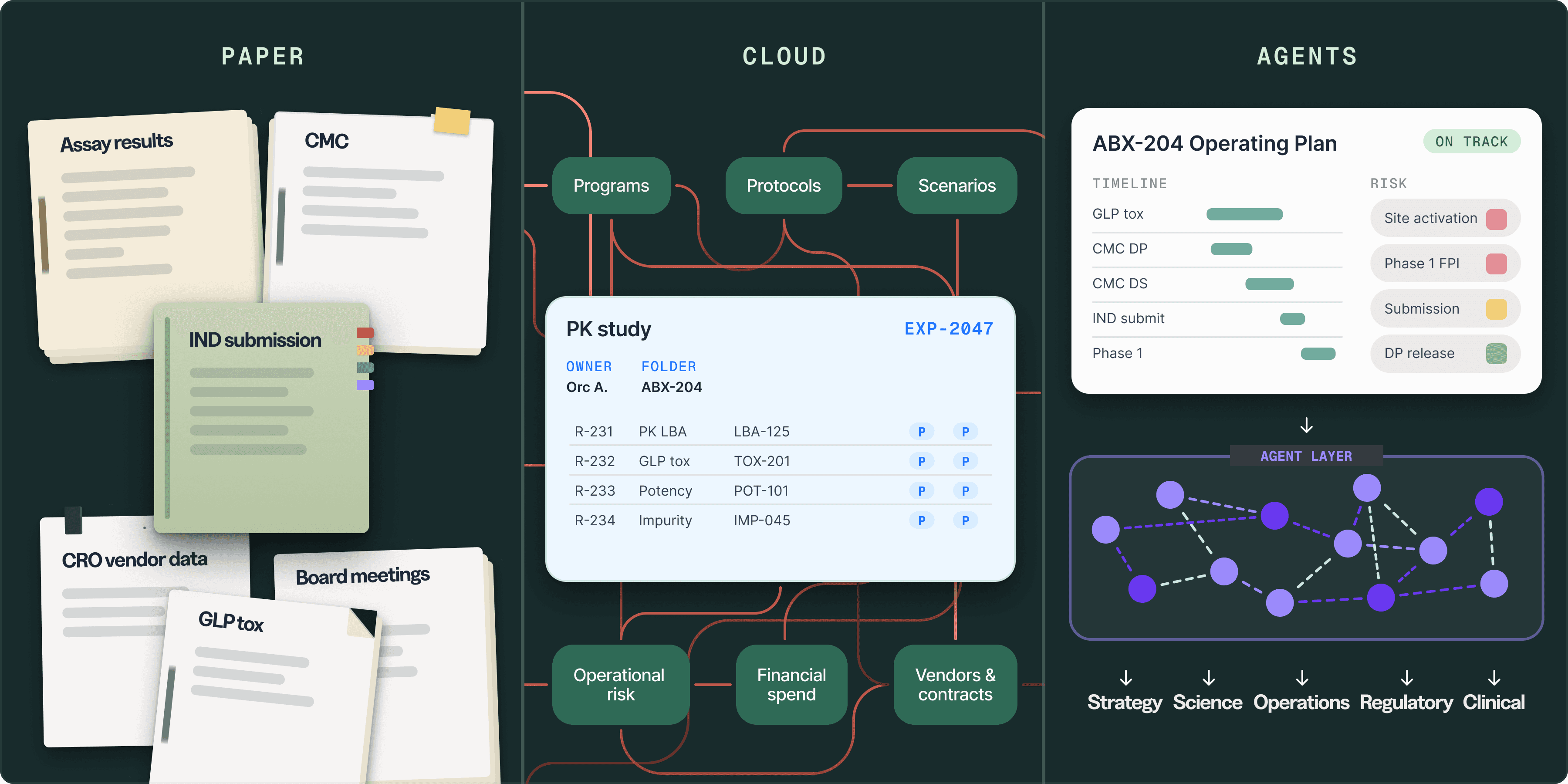
Many biotechs today don't have their own labs. Their team sits in an office orchestrating the work of CROs, CDMOs, and other external partners. The externalization of R&D is increasingly the default model of how drug development happens. Externalization converts fixed lab costs into variable ones, gives teams access to a network of specialized capabilities, and compresses timelines.
A biotech can take a program from discovery through IND submission without a single square foot of lab space. But today, the millions of dollars of externalized R&D that decide the success or failure of a program, are being managed the same way they were a decade ago.
What you gain in speed and cost you lose in control: without rigorous oversight you will lose both. Every experiment running at an external site is a commitment that has to be tracked, reconciled, and managed by someone. When that burden accumulates across multiple projects running in parallel, it becomes a full time job that most teams are not staffed to do well.
You can outsource the work, but not the oversight
In an ideal world, CRO management would be simple. After signing the statement of work (SOW) you’d merely wait for the CRO to deliver the results and/or materials.
Unfortunately these projects don't run themselves. Scientific work changes as it unfolds, and vendors need active direction to keep the work aligned with the program's goals. The work rarely goes exactly to plan. In an in vivo study, tumors may not grow on schedule. A manufacturing run might be delayed. A CRO may ask for a change order, overtime, or holiday coverage to keep animals monitored. Interim data may raise questions the original protocol did not anticipate. Small decisions accumulate quickly, and each one can affect the cost, timeline, or outcome of the study.
Because the work needs steering, someone has to continuously track what every CRO is doing and intervene to drive it to successful outcomes. First there needs to be a plan to track against. A statement of work is a large, complex document, and the deliverables, dates, and payment milestones the CRO is accountable for have to be pulled out of it and transcribed. As the work gets underway, you need to deduce progress and risks from a steady stream of emails, update calls, interim reports, and change orders. Then you have to act on what you find. For example, initial data from an in vivo study may show that a cohort is not responding to treatment. Or a significant deviation in the drug substance or its formulation could be buried hundreds of pages into a manufacturing report.
A single study can be managed in one's head, but not several running in parallel across different CROs and CDMOs. Every study needs its own share of someone's attention, and that bandwidth is scarce. Holding it all together by memory introduces serious scientific and business risk. Historically, this kind of context-rich, reasoning-heavy work could only be done by a person. Today, agents can manage it on your behalf.
How agents manage the work
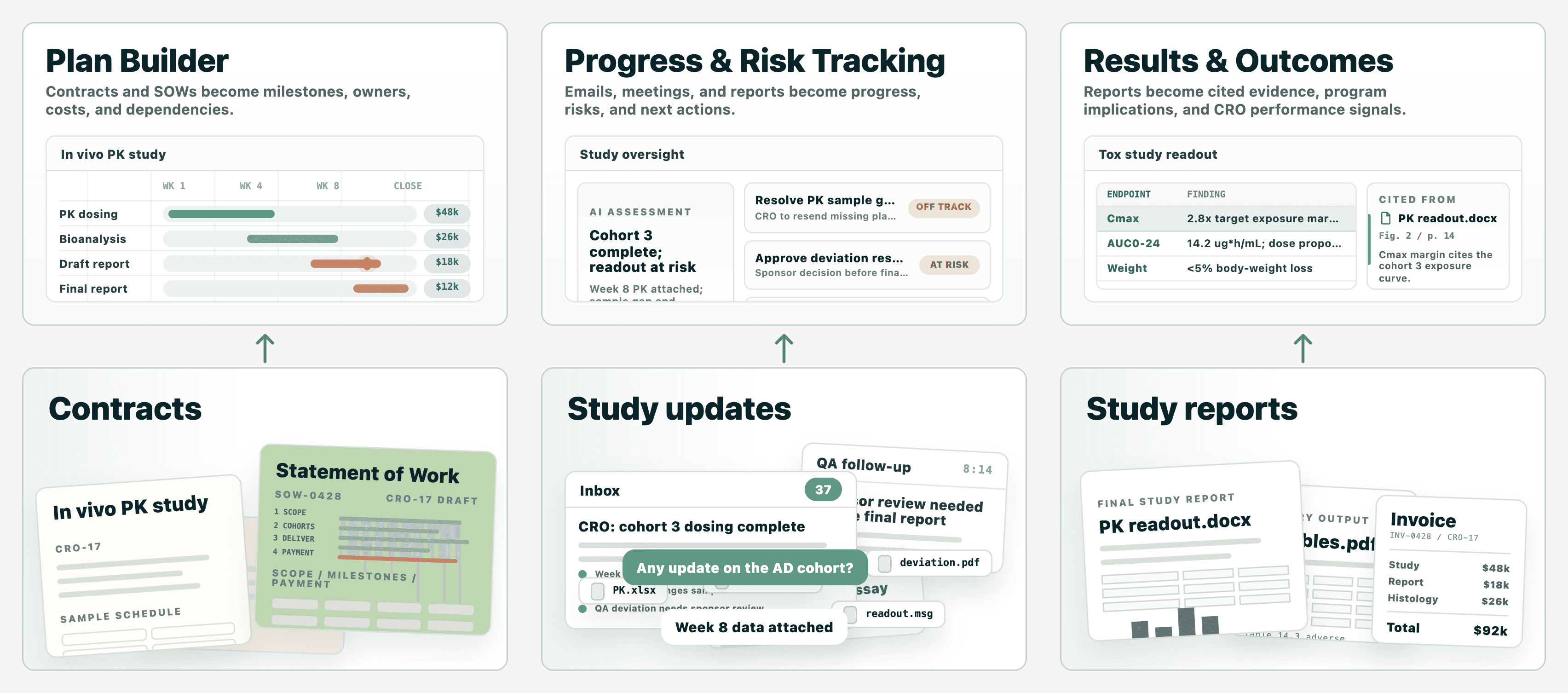
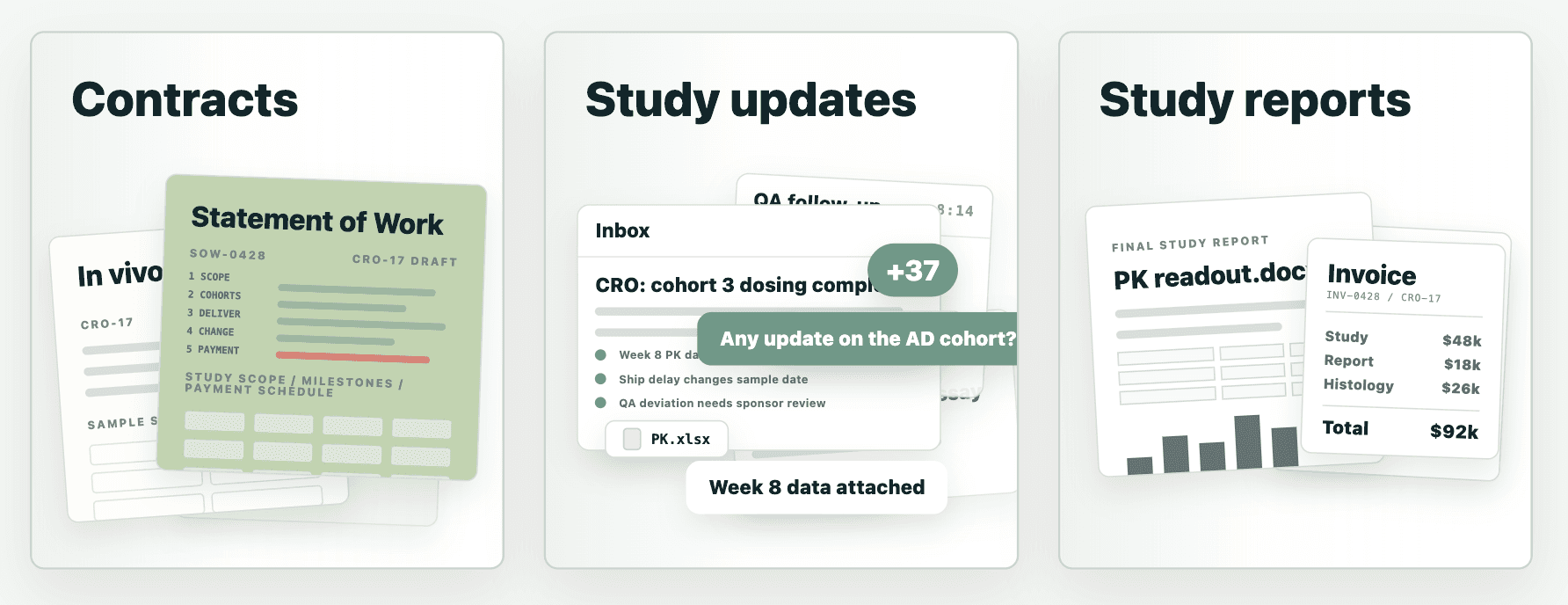
Orchestra's CRO management agents are built around the three jobs that managing a CRO actually entails: These agents turn contracts, emails, meeting notes, reports, and invoices into a project managed on your behalf.
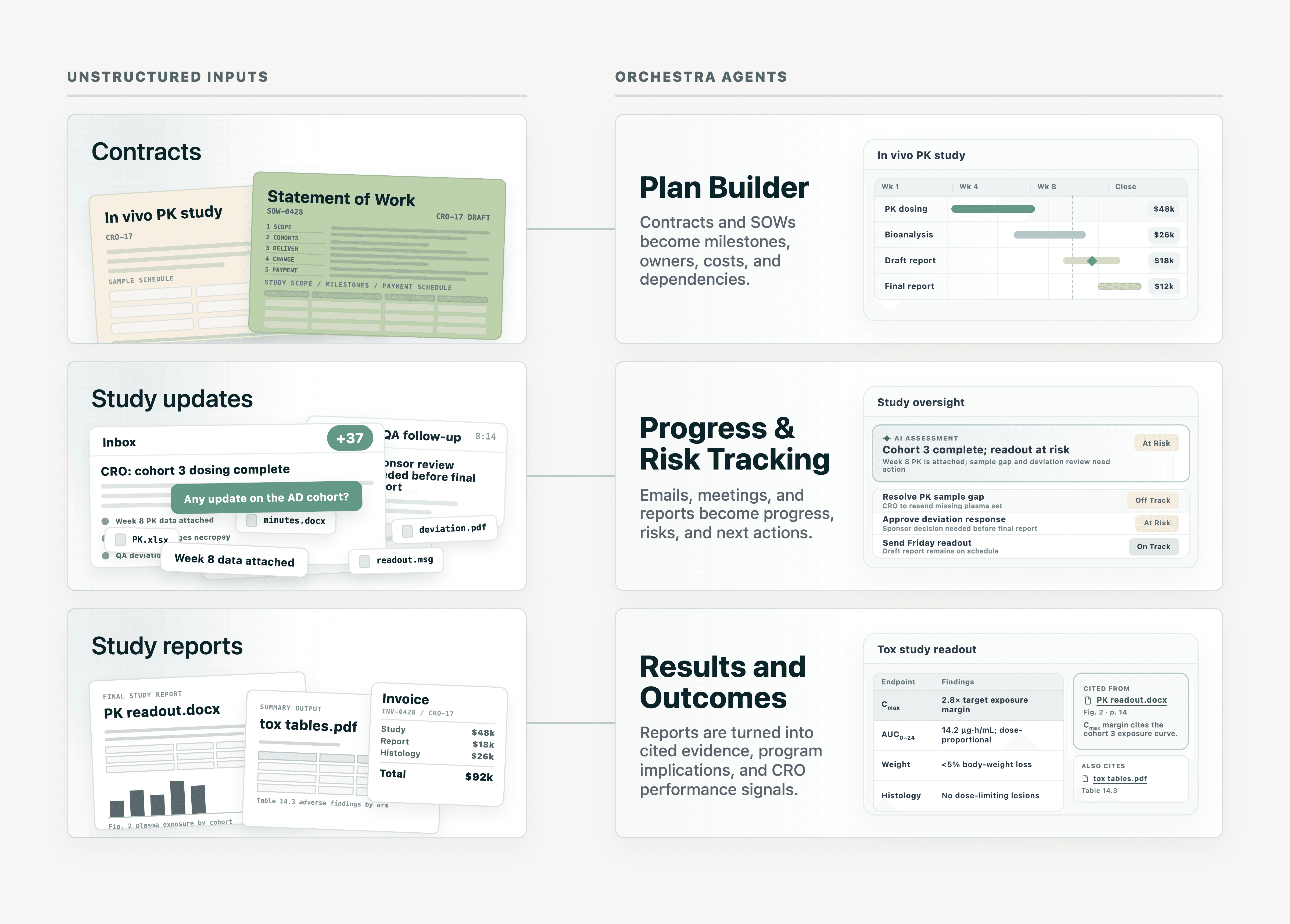
The first job is setting up the engagement. A signed contract has to become a working plan, with owners, due dates, payment triggers, and a clear list of what could go wrong. In most companies that translation happens partially or not at all, because the contract is dense and no one reopens it after signing. Orchestra's contract analyzer reads the SOW, pulls out the contacts, deliverables, payment schedule, and risks buried inside it, and turns a static document into a living plan.
The second job is running the project. Once a study is underway, the sponsor needs the current state of progress and risk against the plan. Rather than reconciling status and chasing updates by hand, Orchestra maintains that picture automatically. Forward emails from your CRO, and it pulls in updates on progress, risks, and outcomes as they land. Connect meeting notes and reports, and it surfaces what is advancing and what is beginning to slip.
The third job is assessing the results. When the work is finished, the sponsor has to confirm that everything paid for was actually delivered. Orchestra reconciles the final deliverables against the contract, using the same emails, notes, and reports it has already read. It then analyzes the results to determine whether the study’s goals were met.
Small teams get more leverage
The immediate return is bandwidth, and the long term benefit is improved control over outcomes and milestones. The tracking and reconciling that used to consume a person's week is handled for them, so a small team can oversee more studies at once and spend their attention on the decisions that actually need it. They can steer their external work toward the outcomes they want, instead of reconstructing what happened after the fact. Over time, that pays off in the work itself. Problems get caught early enough to correct, fewer studies slip or run over budget, and more of them reach the outcome they were designed to.
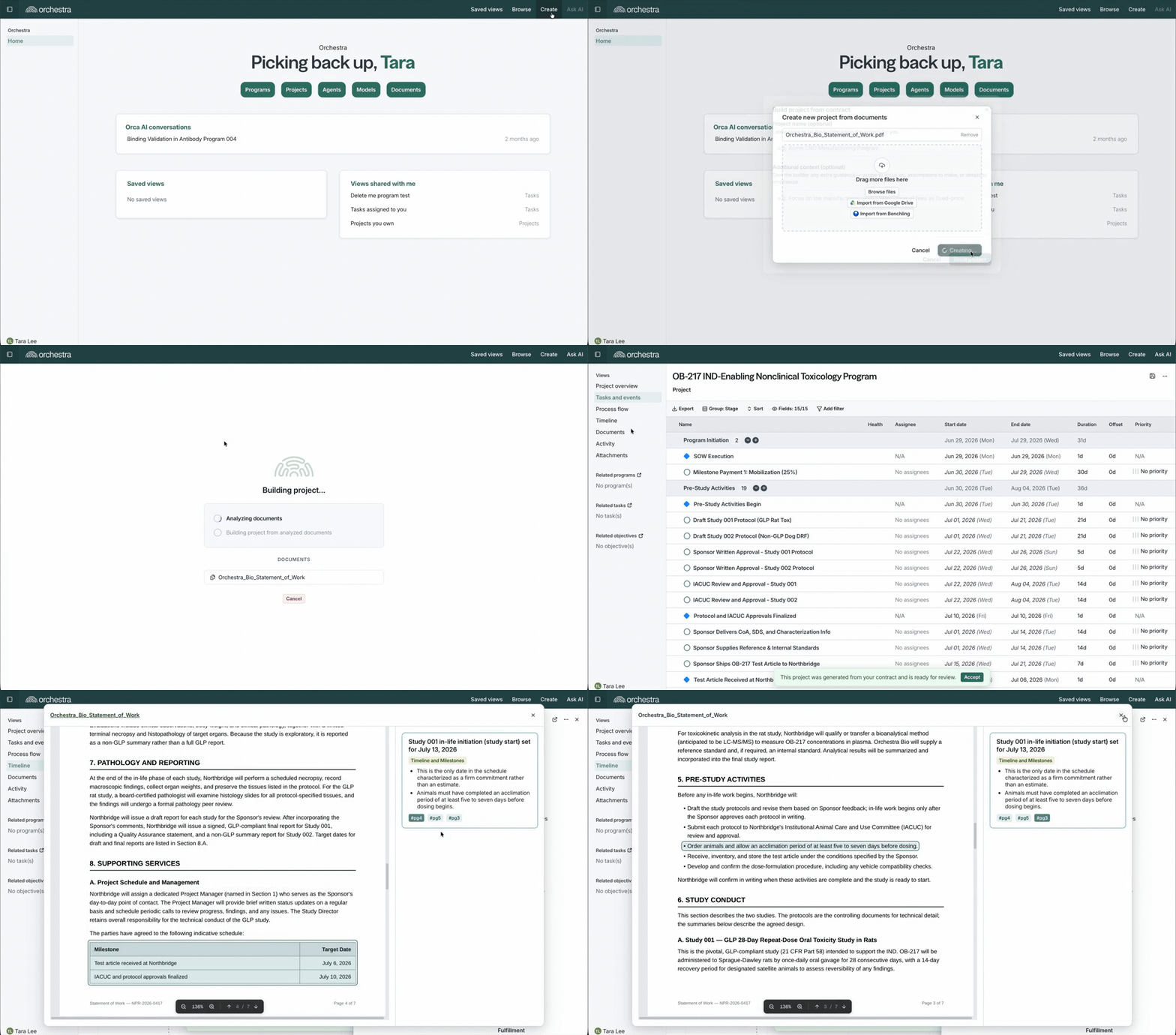
Managing this workflow with agents has a compounding benefit. Everything that Orchestra pulls out of a CRO engagement (i.e., deliverables, spend, risks, outcomes) is captured as queryable knowledge. It feeds the rest of the Orchestra ecosystem, so the same contract that drives a study plan also rolls up to the program timeline and budgets. Study outcomes can be incorporated into program decisions. As time goes on, you can assess the performance and track record of your CROs, to determine whether to use them in future programs. On the scientific side, the findings of every study become retrievable and reportable, including the details buried hundreds of pages into a report.
Externalization made it possible to build a drug company without building a lab, but you trade control and oversight for speed and cost. Agents give you the bandwidth and resources of a larger team while staying nimble. If you want to manage your external R&D with agents, get in touch.
Share this article